
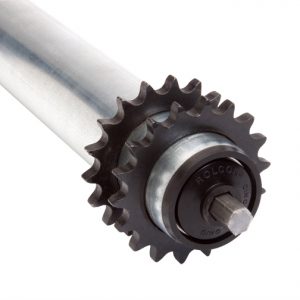

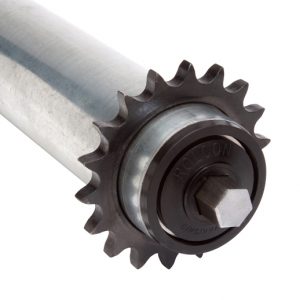
Sprocket rollers are powered by a chain and sprocket to provide light to heavy-duty material handling on your conveyor line, which is why they are sometimes called Chain-Driven Rollers (CDLR).
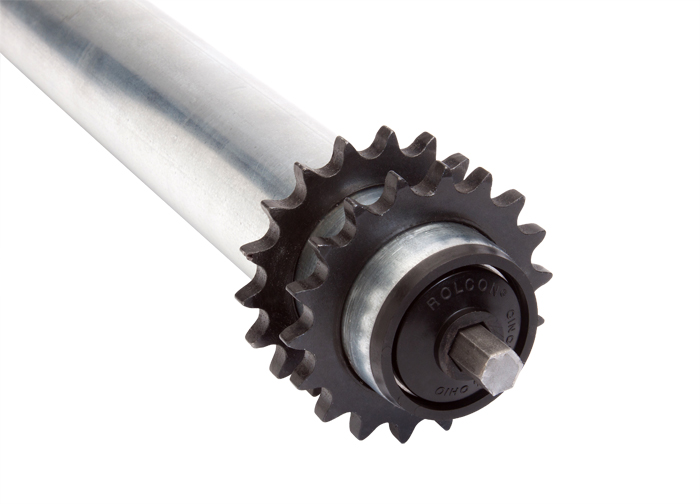
Sprocket rollers provide an economical way to create or add to an existing powered conveyor system. The rollers with sprockets are available with either single or double sprockets and are welded onto the roller tube. Double sprocket conveyor rollers are ideal for heavy-duty material handling applications, while single sprocket pallet rollers work well for light-duty pallet roller conveyor systems.
Features:
- Galvanized steel tube
- Commercial or ABEC 1 precision bearings
- Spring-loaded on both ends
- Crimped tube ends
- Conductive bushing and bearing cap
Technical Specifications:
1.9 diameter roller sprocket
- 15 tooth sprocket – #50 chain
- 18 tooth sprocket – #40 chain
2.5 diameter roller sprocket
- 15 tooth sprocket – #60 chain
- 18 tooth sprocket – #50 chain
- Other sprockets available upon request
- Sprockets can be located anywhere along the roller.
Rolcon Rollers also offers custom machine shop services to produce precise parts for any need.
Frequently Asked Questions
There is no “standard” pallet roller. Weight capacity is determined by the diamter of the roller, the bearing being used and the axle size. The thickness of the tubing will also have some lesser effect on the capacity. The maximum capacity must be calculated based on the application.
The rollers on our site are our standard offerings. If you can’t find the roller you are looking for call or send and email. We do a lot of custom rollers and we can probably help you with a custom roller.
There are many ways an axle can be retained. The most common and standard way is with a spring on both sides of the axle for ease of installation. But we offer other ways to retain the axle. Call us for your specific application.
We do require a number of dimensions in order to make sure you get the correct roller. Typical dimensions are: Diameter of the tube, gage of the tube, length, size and configuration of the axle, the between frame dimension and the bearing set.
If you have any questions on how to order your roller you can always email or give us a call. You can also click here to get our instructions on how to measure your conveyor roller.
Check out this guide for all of the information we require to insure the proper sizing of your replacement roller. chrome-extension://efaidnbmnnnibpcajpcglclefindmkaj/https://www.rolconrollers.com/wp-content/uploads/2021/05/How-To-Measure-A-Conveyor-Roller.pdf
A good rule of thumb is if your conveyor is running at 200′ per minute and HIGHER then a precision bearing will give you the most benefits. Lower than that a non-precision bearing will work well.
You can spot a failing bearing by looking for these four early warnng signs: Auditory – grinding or screeching, clicking or rhythmic popping and increased hum. Touch – heat and vibration. Is the bearing excessively hot to the touch? Is the frame vibrating more to the touch? Both of these indicate a failing bearing. Spin – If the roller is not spinning freely OR there is excessive wobble between the bearing and the axle the bearing could be going bad. Visual – If the bearing is “bleeding” grease or there is metal dust around the bearing it could be a sign that the bearing is going bad.